Difference Between Hollyland Lark M2S and Canon Eos R50 V Explained
In the rapidly evolving world of content creation, the technical barriers to entry have never been lower, yet the complexity of choosing the right gear has never been higher. For modern creators—vloggers, YouTubers, and social media influencers—the debate often centers on whether to invest more heavily in visual fidelity or audio clarity. Two prominent pieces of hardware that frequently appear in these discussions, despite serving fundamentally different purposes, are the Hollyland Lark M2S wireless microphone system and the Canon EOS R50 V mirrorless camera. While one is a dedicated audio solution and the other is a visual powerhouse, understanding how they differ and, more importantly, how they complement each other is essential for anyone looking to produce professional-grade video content.
This comparison is unique because it pits a specialized peripheral against a primary recording device. However, in the context of a "vlogging kit" or "starter setup," buyers often find themselves weighing the cost of a high-end microphone against the cost of a camera body that features a slightly better built-in audio preamp. By examining the Hollyland Lark M2S and the Canon EOS R50 V in detail, we can uncover the nuances of how these tools impact the production workflow and the final quality of the viewer's experience.

Understanding the Core Functions
The Canon EOS R50 V represents the fifth iterative stage of Canon's entry-level APS-C mirrorless lineup, designed specifically to bridge the gap between smartphone photography and professional cinematography. It is the "brain" of the operation, responsible for capturing light, processing colors, and managing the synchronization of every element in a scene. On the other hand, the Hollyland Lark M2S is a specialized audio transmission system. It is designed to solve the single greatest problem in videography: distance. While a camera like the R50 V can zoom in on a subject from twenty feet away, its built-in microphone cannot "zoom" into the subject’s voice without also capturing every bit of ambient noise in the room.
Therefore, the difference isn't just about technical specifications; it is about the role each plays in the creative ecosystem. The R50 V provides the canvas, while the Lark M2S ensures the narration is captured with surgical precision. Without the former, you have no video; without the latter, your high-definition video is often let down by "echoey" or muffled sound that drives viewers away.
In-Depth Review: Canon EOS R50 V
The Canon EOS R50 V is a compact, lightweight beast that focuses on ease of use without sacrificing the "Canon look"—a specific color science that makes skin tones appear natural and vibrant. It utilizes a 24.2-megapixel APS-C sensor, which provides a significant jump in depth-of-field control compared to the small sensors found in even the most expensive smartphones. For the vlogger, this means achieving that "blurry background" (bokeh) effect is much more attainable.
One of the standout features of the R50 V is its Dual Pixel CMOS AF II. This autofocus system is legendary in the industry for its ability to track human eyes and faces with near-perfect accuracy. Whether you are moving toward the camera or walking through a crowded street, the R50 V stays locked onto the subject. For solo creators who don't have a camera operator to pull focus, this reliability is priceless. It also supports 4K video oversampled from 6K, resulting in crisp, detailed footage that holds up well during the editing process.
However, the R50 V is not without its limitations. Being an entry-level professional camera, it lacks some of the more advanced internal cooling systems found in higher-end models like the R6 or R3. While perfect for shorter clips and standard vlogs, it may struggle with overheating during long-form 4K recording in hot environments. Additionally, while it features a 3.5mm microphone input, the internal preamps—the components that boost the audio signal—are relatively standard. This is where a dedicated system like the Lark M2S becomes a necessary upgrade rather than an optional luxury.
Pros of Canon EOS R50 V
- Industry-leading autofocus with eye and face tracking makes solo filming effortless.
- Excellent color science that requires minimal post-production grading for natural-looking results.
- Compact and lightweight chassis, ideal for all-day handheld use or mounting on small gimbals.
- Fully articulating touchscreen allows creators to monitor themselves while filming.
- High-quality 4K oversampled footage provides professional clarity for social media platforms.
Cons of Canon EOS R50 V
- Limited internal audio control compared to dedicated audio recorders.
- Potential for overheating in 4K during extended recording sessions in high-temperature settings.
- Smaller battery life compared to full-frame professional bodies, necessitating extra batteries.
- Limited selection of native RF-S lenses, though compatible with the full RF lens library.
In-Depth Review: Hollyland Lark M2S
The Hollyland Lark M2S is the "S" variant of the popular Lark M2 series, focusing on a balance between extreme portability and professional transmission range. In the world of wireless audio, size used to be a major hurdle. Lavaliere microphones were often bulky packs that had to be clipped onto belts with wires snaking under shirts. The Lark M2S changes this entirely by utilizing a button-sized transmitter that weighs roughly the same as a few paperclips.
Despite its diminutive size, the Lark M2S offers 48kHz/24-bit audio recording, which is the gold standard for high-fidelity digital sound. It features Environmental Noise Cancellation (ENC) technology that can be toggled on to filter out the hum of air conditioners or the roar of distant traffic. This is a crucial feature for creators who often film on location rather than in a sound-treated studio.
The M2S is designed to be "plug-and-play." The receiver clips directly into the 3.5mm jack of the Canon EOS R50 V (or connects via USB-C for mobile workflows), and the two units pair instantly. The transmission range is rated for several hundred feet with a clear line of sight, meaning a creator can walk far away from the R50 V to show off a landscape while still sounding like they are standing two inches away from the listener. For real estate walk-throughs, travel vlogs, or street interviews, this capability is transformative.
Find top-rated Cameras & Photography products at great prices.
View Offers →Pros of Hollyland Lark M2S
- Incredible portability with a transmitter small enough to be worn as a discreet button or magnet.
- Crystal-clear 24-bit audio that significantly outperforms built-in camera microphones.
- Powerful Environmental Noise Cancellation (ENC) for clean recording in noisy surroundings.
- Long battery life with a charging case that provides multiple full recharges for the system.
- Universal compatibility with cameras, smartphones, and computers via various connectors.
Cons of Hollyland Lark M2S
- Extremely small transmitters can be easier to lose if not stored properly in the charging case.
- ENC can sometimes sound slightly artificial if used in environments that are already very quiet.
- While range is excellent, physical obstacles like thick walls can still cause signal interference.
- Limited on-device controls; most deep settings are managed via the accompanying mobile app.
Detailed Hardware Comparison
To better understand how these two devices sit in your gear bag, we have outlined the primary technical differences between a high-end mirrorless camera and a high-end wireless audio system.
| Feature | Canon EOS R50 V | Hollyland Lark M2S |
|---|---|---|
| Primary Function | Visual Capture (Photo/Video) | Audio Capture (Wireless) |
| Sensor / Resolution | 24.2MP APS-C CMOS | 48kHz/24-bit Audio Sampling |
| Weight | Approx. 375g (Body with Battery) | Approx. 9g (Transmitter) |
| Connectivity | Micro-HDMI, USB-C, 3.5mm Mic In | 3.5mm TRS, USB-C, Lightning |
| Storage | SD/SDHC/SDXC (UHS-I) | Transmitted to Camera/Phone |
| Power Source | LP-E17 Rechargeable Battery | Internal Battery + Charging Case |
| Monitoring | 3.0-inch Articulating LCD | LED Status Indicators / App |
Why the Difference Matters to the Buyer
When looking at the Hollyland Lark M2S vs. the Canon EOS R50 V, a buyer isn't choosing between "Brand A" and "Brand B" for the same task. Instead, they are deciding where to allocate their budget. A common mistake among beginners is to spend 100% of their budget on the best possible camera body (like the R50 V) and rely on the internal microphone for sound. This leads to a mismatched experience: 4K visuals paired with 1990s-quality audio.
The "Difference" that buyers care about most is the Audio-Visual Gap. The Canon R50 V is designed to capture the light of the world, but it is physically limited in how it captures sound. Sound intensity follows the inverse square law, meaning the further you are from the camera, the exponentially quieter and more distorted your voice becomes. The Hollyland Lark M2S bridges this gap by placing the "ear" of the camera (the microphone) directly on your lapel, regardless of how far the "eye" (the R50 V lens) is located.
Furthermore, the R50 V offers professional-grade controls for exposure, ISO, and shutter speed, but it provides very little in terms of real-time audio manipulation. The Lark M2S adds that missing layer. It allows for gain adjustment and noise filtering before the sound even hits the camera’s memory card. For a buyer, the R50 V is the foundation, and the Lark M2S is the critical infrastructure that allows that foundation to be seen and heard effectively.
Real-World Use Cases
Scenario 1: The Solo Travel Vlogger
Imagine filming a vlog at a crowded Italian train station. If you only have the Canon EOS R50 V, you must keep the camera very close to your face to ensure the microphone picks up your voice. This limits your compositions; you can't show the architecture of the station or the trains behind you. By adding the Hollyland Lark M2S, you can place the R50 V on a tripod ten feet away, walk through the crowd, and describe the scene in a normal speaking voice. The Lark M2S will isolate your voice, while the R50 V captures the wide, cinematic beauty of the location.
Scenario 2: The Fitness Instructor
For a fitness YouTuber, movement is constant. When performing a squat or a sprint, keeping a camera pointed at you is easy (thanks to the R50 V’s autofocus), but keeping your voice consistent is impossible if you are moving away from or toward the camera's built-in mic. The Lark M2S stays attached to the instructor's shirt, providing a consistent volume and tone regardless of the physical distance or the orientation of their body. The R50 V handles the fast-moving visual tracking, and the M2S handles the heavy breathing and instructional cues without distortion.
Scenario 3: The Corporate Interviewer
In a professional interview setting, the Canon EOS R50 V can be set to a "Face Tracking" mode to ensure the subject is always crisp. However, a camera on a tripod often sits several feet away from the subject. Using the Hollyland Lark M2S allows the interviewer to clip a tiny, nearly invisible microphone to the subject’s clothing. This eliminates the need for expensive, heavy boom arms and ensures that the interview sounds intimate and professional, matching the high-quality 4K video produced by the Canon sensor.
Buying Guide: Which Should You Prioritize?
If you are starting from scratch, the Canon EOS R50 V is your first priority. You cannot record video without a camera, and the R50 V is one of the best value-for-money propositions on the market for its autofocus and color science. It provides the essential starting point for any creative journey.
However, if you already own a decent camera (even a smartphone or an older mirrorless model) and you are looking to "level up" the professionalism of your content, the Hollyland Lark M2S is often the better investment than a newer camera body. Viewers will generally tolerate a lower-resolution video if the audio is clear, but they will almost immediately turn off a 4K video if the audio is scratchy, quiet, or filled with wind noise.
Find top-rated Cameras & Photography products at great prices.
Shop Amazon →For those building a comprehensive kit, these two devices should be viewed as a pair. The R50 V provides the 10-bit or 8-bit visual data that makes your content look "expensive," and the Lark M2S provides the 24-bit audio data that makes your content sound "authoritative." Together, they cover the two most important human senses engaged by digital media.
Look for the R50 V if: You need a primary camera that handles autofocus better than your phone, or if you want to start using interchangeable lenses to get different visual "looks."
Look for the Lark M2S if: You are tired of your voice sounding distant in your videos, you frequently film outdoors, or you want to start conducting interviews and need a reliable, tiny microphone that won't distract the subject.
The Technical Synergy
One of the most impressive aspects of using the Hollyland Lark M2S with the Canon EOS R50 V is how well they sync up. The R50 V has a menu setting for "Audio Recording." By setting this to "Manual" and turning the internal gain down to a low level, and then letting the Lark M2S handle the signal boosting, you drastically reduce the "hiss" (digital floor noise) in your recordings. This specific combination is a favorite among mid-tier creators because it mimics the performance of setups that cost three times as much.
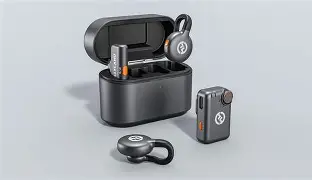
The physical size also creates synergy. The R50 V is small enough to fit in a jacket pocket, and the Lark M2S case is about the size of a jewelry box. This means you can carry a professional-level production studio in a small sling bag. In the era of mobile-first content, this portability is a competitive advantage. You can set up, film, and pack away in minutes, whereas traditional professional gear might take half an hour to assemble.
Conclusion
The difference between the Hollyland Lark M2S and the Canon EOS R50 V is fundamentally the difference between "hearing" and "seeing." The Canon EOS R50 V is an exceptional visual tool, offering the latest in autofocus technology and sensor performance to ensure that every frame of your video is sharp, color-accurate, and professional. It is the heart of the content creation process, providing the necessary resolution and depth that viewers expect in 2026.
Conversely, the Hollyland Lark M2S is the voice of your content. It solves the environmental and spatial challenges that even the best cameras cannot overcome on their own. By providing a stable, high-fidelity wireless connection between the speaker and the camera, it ensures that your message is delivered clearly, without the interference of background noise or the degradation of distance. While they are different categories of equipment, they are two sides of the same coin. For the creator who wants to stand out, the R50 V provides the image, but the Lark M2S provides the impact. Investing in both ensures that your production value is balanced, professional, and ready for any platform.